Note
Go to the end to download the full example code.
Preprocessing transformers and scikit-learn compatibility
SpectroChemPy preprocessing operations can be used as transformer objects
with an explicit fit() / transform() lifecycle. Feature-wise
scalers learn statistics from a training set and reuse them on new data.
Sample-local operations such as SNV and spectral normalization compute
each observation’s statistics during transform() and do not support a
safe inverse without result-attached per-observation state.
The transformers also expose get_params() / set_params() so they
work with sklearn.base.clone() when scikit-learn is installed.
Load data
import numpy as np

import spectrochempy as scp

dataset = scp.read_omnic("irdata/nh4y-activation.spg")
region = dataset[:, 4000.0:2000.0]
Train / test split
We keep the first 40 spectra for training and the rest for testing.
Stateful scaling with AutoscaleTransformer
fit_transform() learns the mean and std on train (per wavenumber,
dim='y'), then scales train. transform() later applies the
same parameters to test — no data leakage.
scaler = scp.AutoscaleTransformer(dim="y")
X_train_scaled = scaler.fit_transform(X_train)
X_test_scaled = scaler.transform(X_test)

_ = X_train_scaled.plot(title="Train set (autoscaled)")
_ = X_test_scaled.plot(title="Test set (same scaler)")
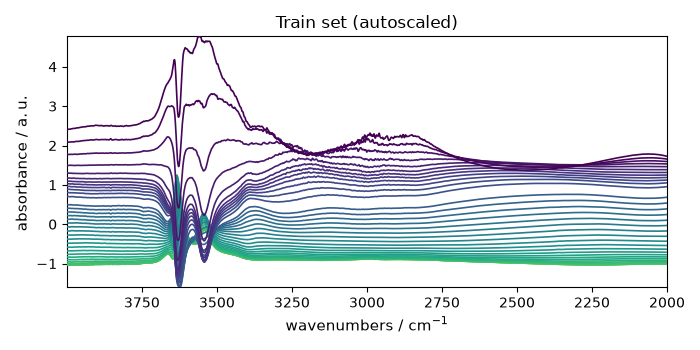
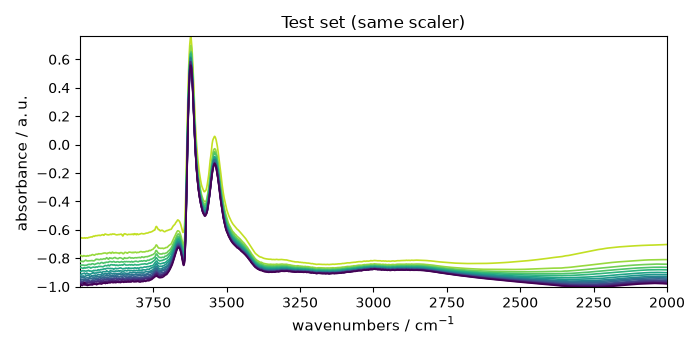
Inspecting learned parameters
The transformer stores the statistics as NumPy arrays.
print("Mean shape:", scaler.mean_.shape)
print("Std shape:  ", scaler.std_.shape)
Mean shape: (1, 2075)
Std shape:   (1, 2075)
Parameter inspection with get_params / set_params
Transformers follow scikit-learn parameter conventions.
print("Original params:", scaler.get_params())

# Change the target dimension
scaler.set_params(dim="x")
print("After set_params:", scaler.get_params())
Original params: {'dim': 'y'}
After set_params: {'dim': 'x'}
sklearn.base.clone compatibility
When scikit-learn is available, transformers can be cloned exactly like any sklearn estimator.
try:
    from sklearn.base import clone

    original = scp.AutoscaleTransformer(dim="x")
    original.fit(X_train)

    cloned = clone(original)
    print("Clone has same params:", cloned.get_params() == original.get_params())
    print("Clone is not fitted yet:", not cloned._fitted)
except ImportError:
    print("scikit-learn not installed — clone example skipped")
Clone has same params: True
Clone is not fitted yet: True
Inverse transform
inverse_transform() restores the original absorbance units. This
is useful when interpreting model predictions (e.g., converting
PCA scores back to original space). Since changing parameters invalidates
fitted transformer state, set the intended parameters and fit before
inverting.
scaler.set_params(dim="y")
scaler.fit(X_train)
X_train_restored = scaler.inverse_transform(X_train_scaled)
print(
    "Restored data matches original?",
    np.allclose(X_train_restored.data, X_train.data),
)
Restored data matches original? True
Uncomment the following line to display all figures when running the script directly with Python.
# scp.show()
Total running time of the script: (0 minutes 0.448 seconds)