Time domain baseline correction (NMR)
Here we show how to baseline correct dataset in the time domain before applying FFT.
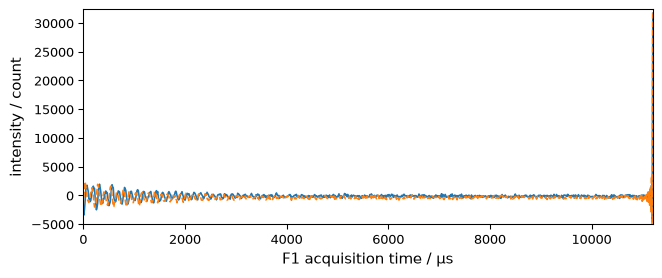
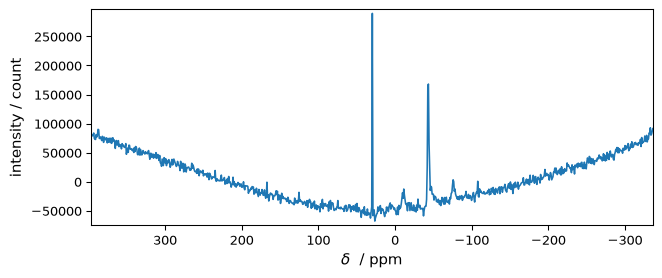
The example spectra were downloaded from a historical University of Tubingen NMR processing page describing DC-offset correction. That original external page is no longer reliably reachable, so the example below focuses on the SpectroChemPy workflow directly.
[1]:
import spectrochempy as scp
[2]:
# This example uses Bruker NMR data.
#
# Requires the official ``spectrochempy-nmr`` plugin.
# Install with: ``pip install spectrochempy[nmr]``.
[3]:
path = scp.preferences.datadir / "nmrdata" / "bruker" / "tests" / "nmr" / "h3po4"
fid = scp.nmr.read(path, expno=4)
prefs = scp.preferences
prefs.figure.figsize = (7, 3)
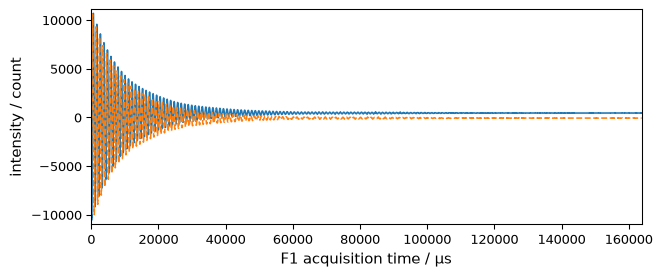
_ = fid.plot(show_complex=True)
[4]:
spec = scp.fft(fid)
_ = spec.plot(xlim=(5, -5))
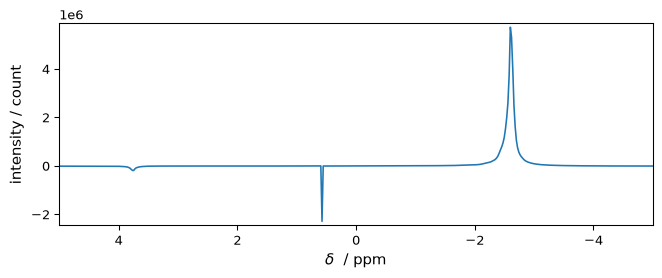
We can see that in the middle of the spectrum there are an artifact (a transmitter spike) due to different DC offset between imaginary.
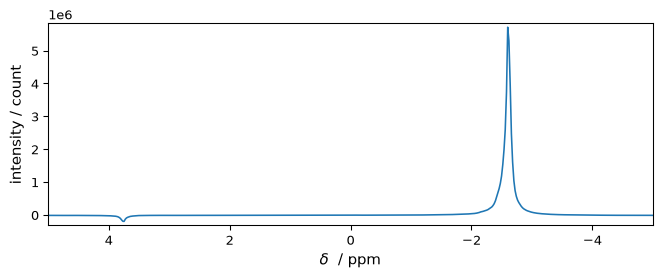
In SpectroChemPy, for now, we provide a simple kind of dc correction using the dccommand.
[5]:
dc_corrected_fid = fid.dc()
spec = scp.fft(dc_corrected_fid)
_ = spec.plot(xlim=(5, -5))
[6]:
path = scp.preferences.datadir / "nmrdata" / "bruker" / "tests" / "nmr" / "cadmium"
fid2 = scp.nmr.read(path, expno=100)
_ = fid2.plot(show_complex=True)
WARNING | (UserWarning) (956,)cannot be shaped into(1024,)
[7]:
spec2 = scp.fft(fid2)
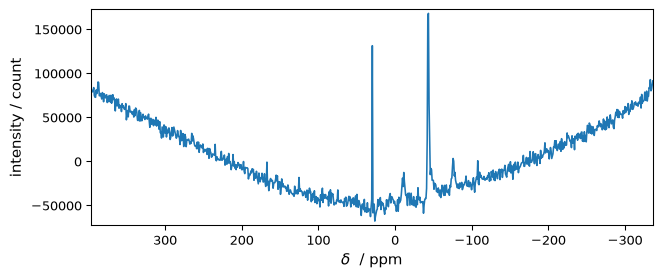
_ = spec2.plot()
[8]:
dc_corrected_fid2 = fid2.dc()
spec2 = scp.fft(dc_corrected_fid2)
_ = spec2.plot()