Note
Go to the end to download the full example code.
Preprocessing transformers and scikit-learn compatibility
SpectroChemPy preprocessing operations can be used as transformer objects
with an explicit fit() / transform() lifecycle. Feature-wise
scalers learn statistics from a training set and reuse them on new data.
Sample-local operations such as SNV and spectral normalization compute
each observation’s statistics during transform() and do not support a
safe inverse without result-attached per-observation state.
The transformers also expose get_params() / set_params() so they
work with sklearn.base.clone() when scikit-learn is installed.
Load data
import numpy as np

import spectrochempy as scp

dataset = scp.read_omnic("irdata/nh4y-activation.spg")
region = dataset[:, 4000.0:2000.0]
Train / test split
We keep the first 40 spectra for training and the rest for testing.
Stateful scaling with AutoscaleTransformer
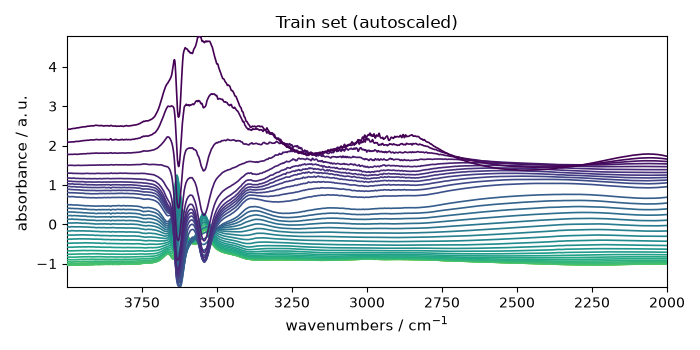
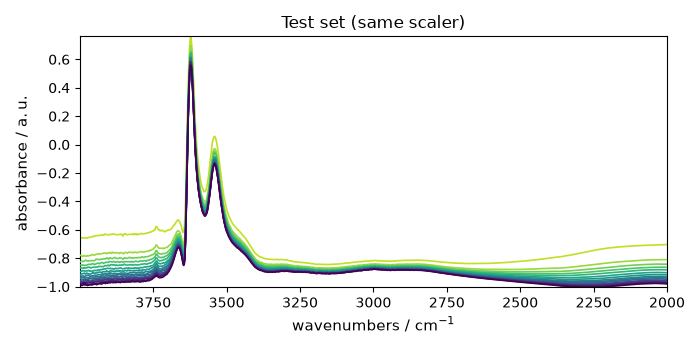
fit_transform() learns the mean and std on train (per wavenumber,
dim='y'), then scales train. transform() later applies the
same parameters to test — no data leakage.
scaler = scp.AutoscaleTransformer(dim="y")
X_train_scaled = scaler.fit_transform(X_train)
X_test_scaled = scaler.transform(X_test)

_ = X_train_scaled.plot(title="Train set (autoscaled)")
_ = X_test_scaled.plot(title="Test set (same scaler)")
Inspecting learned parameters
The transformer stores the statistics as NumPy arrays.
print("Mean shape:", scaler.mean_.shape)
print("Std shape:  ", scaler.std_.shape)
Mean shape: (1, 2075)
Std shape:   (1, 2075)
Parameter inspection with get_params / set_params
Transformers follow scikit-learn parameter conventions.
print("Original params:", scaler.get_params())

# Change the target dimension
scaler.set_params(dim="x")
print("After set_params:", scaler.get_params())
Original params: {'dim': 'y'}
After set_params: {'dim': 'x'}
sklearn.base.clone compatibility
When scikit-learn is available, transformers can be cloned exactly like any sklearn estimator.
try:
    from sklearn.base import clone

    original = scp.AutoscaleTransformer(dim="x")
    original.fit(X_train)

    cloned = clone(original)
    print("Clone has same params:", cloned.get_params() == original.get_params())
    print("Clone is not fitted yet:", not cloned._fitted)
except ImportError:
    print("scikit-learn not installed — clone example skipped")
Clone has same params: True
Clone is not fitted yet: True
Inverse transform
inverse_transform() restores the original absorbance units. This
is useful when interpreting model predictions (e.g., converting
PCA scores back to original space).
X_train_restored = scaler.set_params(dim="y").inverse_transform(X_train_scaled)
print(
    "Restored data matches original?",
    np.allclose(X_train_restored.data, X_train.data),
)
Restored data matches original? True
# Uncomment the following line to display all figures when running the script
# directly with Python.
#
# scp.show()
Total running time of the script: (0 minutes 0.441 seconds)