Note
Go to the end to download the full example code
NMR: reading TopSpin files (plugin)
This example shows how to read Bruker TopSpin NMR files using the
optional spectrochempy-nmr plugin.
It also compares a simple public SpectroChemPy reconstruction of the raw TopSpin FID against the bundled TopSpin processed reference spectrum.
Requires the official spectrochempy-nmr plugin.
Install with: pip install spectrochempy[nmr].
import numpy as np

import spectrochempy as scp
The recommended public reader lives under the scp.nmr plugin namespace.
The longer scp.nmr.read_topspin and top-level scp.read_topspin forms
remain available for compatibility.
fid = scp.nmr.read(
    scp.preferences.datadir / "nmrdata" / "bruker" / "tests" / "nmr" / "topspin_1d",
    expno=1,
    remove_digital_filter=True,
)
print(f"Loaded raw FID: {fid}")
print(f"Shape: {fid.shape}")
Loaded raw FID: NDDataset: [complex128] count (size: 12411)
Shape: (12411,)
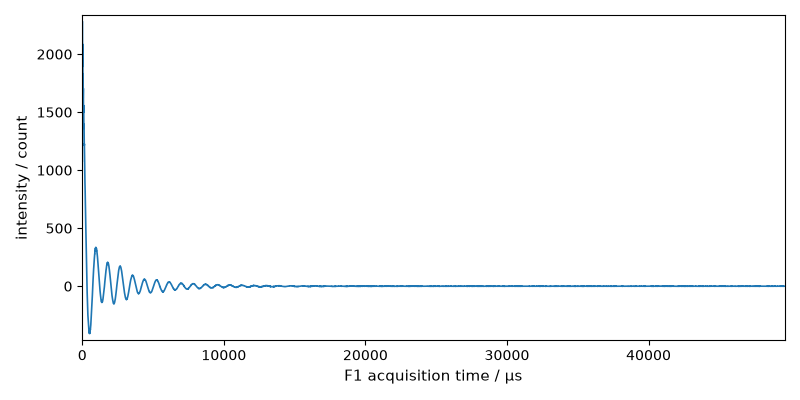
Plot the raw FID:
Read the processed TopSpin reference spectrum.
topspin = scp.nmr.read(
    scp.preferences.datadir / "nmrdata" / "bruker" / "tests" / "nmr" / "topspin_1d",
    expno=1,
    procno=1,
)
print(f"Loaded processed TopSpin spectrum: {topspin}")
print(f"Shape: {topspin.shape}")
Loaded processed TopSpin spectrum: NDDataset: [complex128] count (size: 16384)
Shape: (16384,)
Reconstruct the spectrum from the raw FID with the public API.
For this bundled TopSpin example, the processed reference uses:
- digital-filter correction on the FID;
- no exponential/sine-bell apodization (LB=0, GB=0, SSB=0);
- zero filling to SI=16384.
The FID metadata also carries TopSpin’s stored phasing parameters, and the
public complex FFT path reuses that convention automatically for this direct
1D QSIM dataset.
spectrum = fid.fft(size=int(topspin.meta.si[0]))
Compare the reconstructed spectrum and the TopSpin processed reference on the same ppm grid.
axis = np.asarray(topspin.x.data, dtype=float)
ref = np.asarray(topspin.data).squeeze()
calc = np.asarray(spectrum.data).squeeze()
if axis[0] > axis[-1]:
    axis = axis[::-1]
    ref = ref[::-1]
    calc = calc[::-1]

amplitude_scale = np.vdot(calc, ref) / np.vdot(calc, calc)
maxabs_ratio = np.max(np.abs(ref)) / np.max(np.abs(calc))

ref_norm = ref / np.max(np.abs(ref))
calc_norm = calc / np.max(np.abs(calc))
complex_overlap = np.abs(np.vdot(calc_norm, ref_norm)) / (
    np.linalg.norm(calc_norm) * np.linalg.norm(ref_norm)
)
real_corr = np.corrcoef(calc_norm.real, ref_norm.real)[0, 1]

print(f"Complex overlap with TopSpin reference: {complex_overlap:0.6f}")
print(f"Real-part correlation with TopSpin reference: {real_corr:0.6f}")
print(f"Amplitude scale (calc -> TopSpin): {amplitude_scale.real:0.6f}")
print(f"Amplitude ratio max|TopSpin|/max|calc|: {maxabs_ratio:0.6f}")
Complex overlap with TopSpin reference: 0.999746
Real-part correlation with TopSpin reference: 0.999792
Amplitude scale (calc -> TopSpin): 1.000551
Amplitude ratio max|TopSpin|/max|calc|: 0.999806
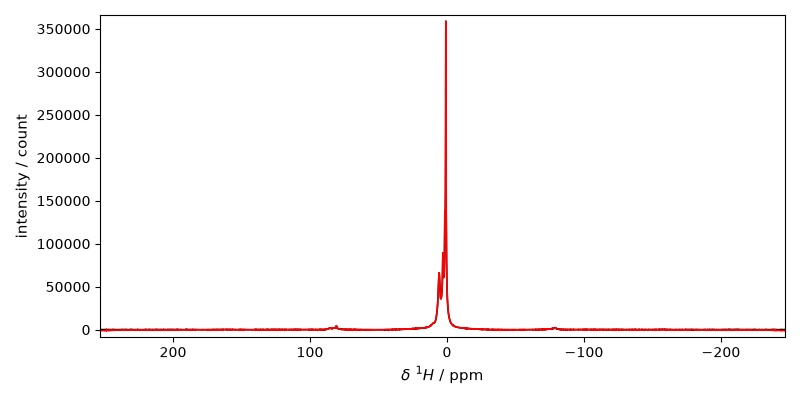
Overlay the real absorptive part against the TopSpin 1r reference.
ax = topspin.real.plot(color="black")
_ = spectrum.real.plot(ax=ax, clear=False, color="red")
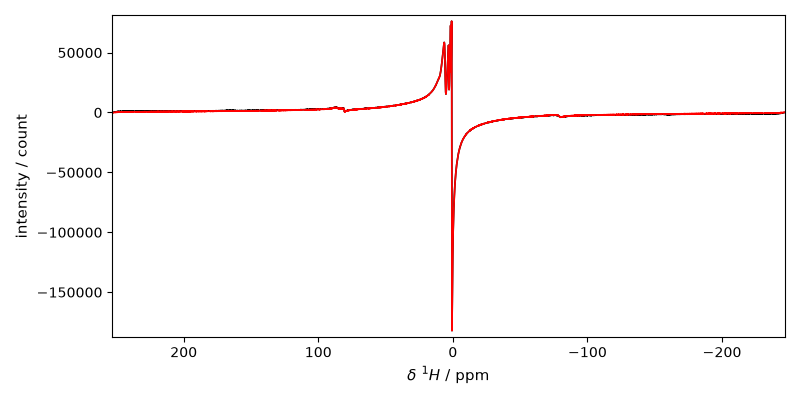
The imaginary parts (1i-like channel) can also be compared directly.
ax = topspin.imag.plot(color="black")
_ = spectrum.imag.plot(ax=ax, clear=False, color="red")
If the plugin is not installed, the function or method raises a
MissingPluginError with installation
instructions.
# scp.show()
Total running time of the script: ( 0 minutes 0.512 seconds)