Note
Go to the end to download the full example code.
PLS regression with a Pipeline
This example predicts corn moisture from NIR spectra using a SpectroChemPy
Pipeline. The pipeline learns preprocessing from the calibration spectra
only, then reuses the fitted preprocessing when predicting validation spectra.
Import the packages
import numpy as np

import spectrochempy as scp
Load the corn NIR dataset
The data is available from the Eigenvector archive:
try:
    ds_list = scp.read("http://www.eigenvector.com/data/Corn/corn.mat", merge=False)
except FileNotFoundError:
    ds_list = None
    print(
        "Eigenvector corn dataset not reachable; skipping the remote Pipeline example."
    )
else:
    ds_list_names = [f"{i} : {ds.name}({ds.shape})" for i, ds in enumerate(ds_list)]
    print(ds_list_names)
['0 : m5nbs((3, 700))', '1 : mp5nbs((4, 700))', '2 : mp6nbs((4, 700))', '3 : propvals((80, 4))', '4 : m5spec((80, 700))', '5 : mp5spec((80, 700))', '6 : mp6spec((80, 700))']
if ds_list is not None:
    # Inspect the spectra and select moisture
    # ^^^^^^^^^^^^^^^^^^^^^^^^^^^^^^^^^^^^^^^
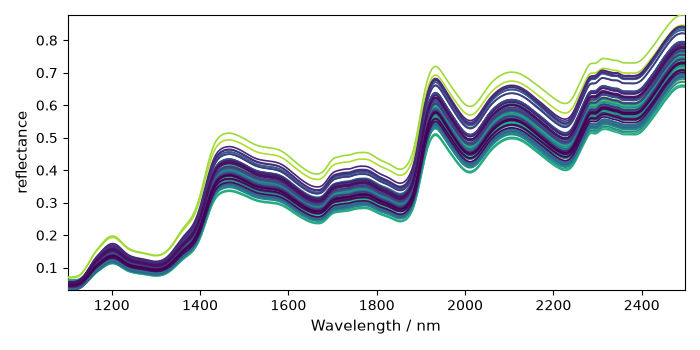
    # The 5th dataset ``m5spec`` contains NIR spectra from 80 corn samples
    # recorded on the same instrument. The properties to predict are in the
    # ``propval`` dataset.
    X = ds_list[4]
    X.title = "reflectance"
    X.x.title = "Wavelength"
    X.x.units = "nm"
    _ = X.plot(cmap=None, show=False)

    Y = ds_list[3]
    y = Y[:, "Moisture"]

    # %%
    # Split calibration and validation samples
    # ^^^^^^^^^^^^^^^^^^^^^^^^^^^^^^^^^^^^^^^^
    # Use regularly spaced samples after sorting by moisture so the validation
    # set spans the concentration range instead of becoming a simple high-index
    # holdout. This deterministic split is used only for demonstration;
    # real validation splits should follow the experimental design.
    moisture_order = np.argsort(np.asarray(y.data).ravel())
    validation_indices = sorted(moisture_order[3::4].tolist())
    calibration_indices = [i for i in range(X.shape[0]) if i not in validation_indices]

    X_cal = X[calibration_indices]
    y_cal = y[calibration_indices]
    X_val = X[validation_indices]
    y_val = y[validation_indices]

    # %%
    # Fit preprocessing and PLS together
    # ^^^^^^^^^^^^^^^^^^^^^^^^^^^^^^^^^^
    # ``AutoscaleTransformer`` owns the centering/scaling step, so the internal
    # scaling of ``PLSRegression`` is disabled to keep responsibilities clear.
    pipeline = scp.Pipeline(
        [
            ("scale", scp.AutoscaleTransformer(dim="y")),
            ("pls", scp.PLSRegression(n_components=5, scale=False)),
        ]
    )
    pipeline.fit(X_cal, y_cal)

    # %%
    # Predict validation samples
    # ^^^^^^^^^^^^^^^^^^^^^^^^^^
    y_val_pred = pipeline.predict(X_val)
    residuals = y_val - y_val_pred
    rmse_val = np.sqrt(np.mean(np.asarray(residuals.data) ** 2))
    units = f" {y_val.units}" if y_val.units else ""
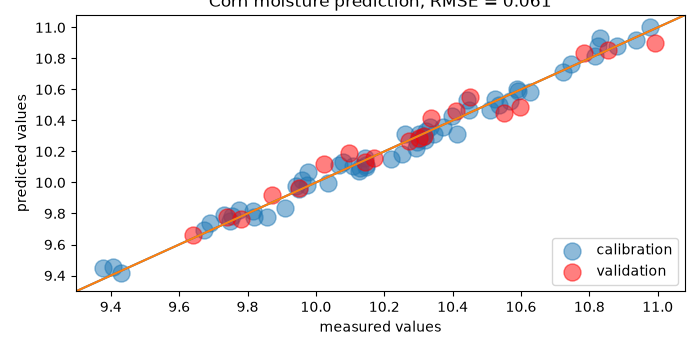
    print(f"Validation RMSE: {rmse_val:.3f}{units}")

    # %%
    # Validate with a parity plot
    # ^^^^^^^^^^^^^^^^^^^^^^^^^^^
    fitted_pls = pipeline.fitted_named_steps_["pls"]
    ax = fitted_pls.plot_parity(label="calibration", s=150, show=False)
    _ = fitted_pls.plot_parity(
        y_val,
        y_val_pred,
        ax=ax,
        s=150,
        c="red",
        label="validation",
        clear=False,
        show=False,
    )
    _ = ax.legend(loc="lower right")
    _ = ax.set_title(f"Corn moisture prediction, RMSE = {rmse_val:.3f}{units}")

    # %%
    # Template and fitted steps
    # ^^^^^^^^^^^^^^^^^^^^^^^^^
    # The public ``steps`` and ``named_steps`` are templates. The fitted scaler
    # used for validation is a fitted clone.
    print(pipeline.named_steps["scale"] is pipeline.fitted_named_steps_["scale"])

    # %%
    # Updating a nested parameter
    # ^^^^^^^^^^^^^^^^^^^^^^^^^^^
    # Any effective ``set_params()`` call invalidates fitted state. Fit again
    # before predicting with the updated configuration.
    pipeline.set_params(pls__n_components=4)
    pipeline.fit(X_cal, y_cal)
    _ = pipeline.predict(X_val)
Validation RMSE: 0.061
False
Uncomment the following line to display all figures when running the script directly with Python.
# scp.show()
Total running time of the script: (0 minutes 1.046 seconds)