Note
Go to the end to download the full example code.
Mask a saturated region and transform an IR dataset
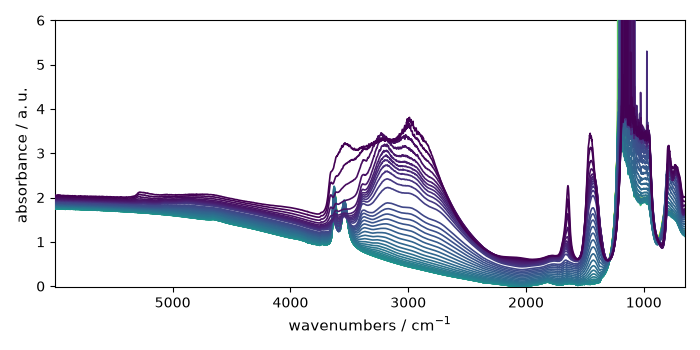
This example shows three common operations on a 2D infrared dataset: masking a saturated region, transposing the dataset, and converting axis units.
import spectrochempy as scp
Load and inspect the dataset
dataset = scp.read_omnic("irdata/nh4y-activation.spg")
dataset.y -= dataset.y[0]
dataset.y.title = "time"

prefs = scp.preferences
prefs.figure.figsize = (7, 3.5)
prefs.colormap = "Dark2"
prefs.colorbar = True
_ = dataset.plot()
Mask a saturated region
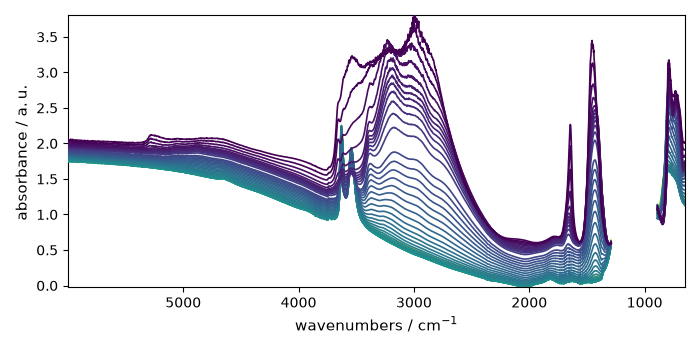
The mask is respected by subsequent operations such as reductions:
dataset.max()
Transpose the dataset
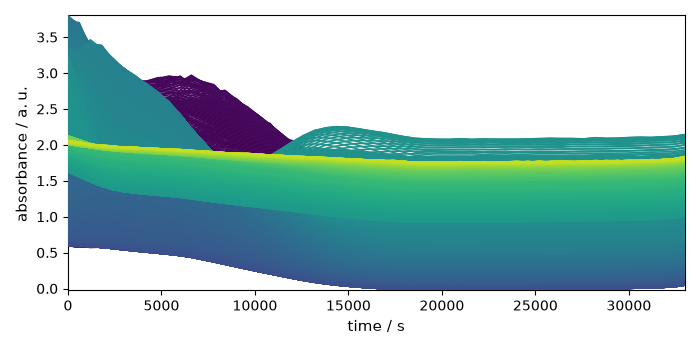
Transposition exchanges axes while preserving data and mask:
transposed = dataset.T
_ = transposed.plot()
Convert coordinate units
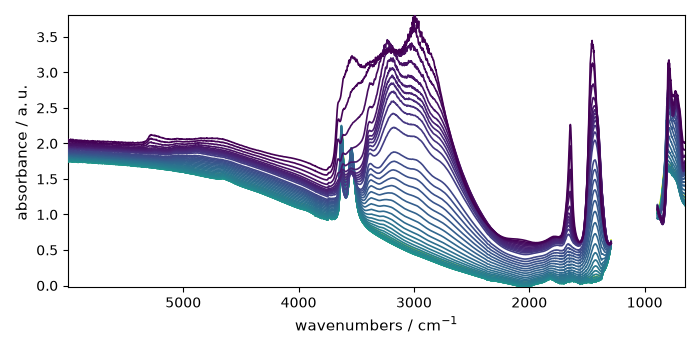
dataset.y.ito("hours")
_ = dataset.plot()
Uncomment the following line to display all figures when running the script directly with Python.
# scp.show()
Total running time of the script: (0 minutes 5.144 seconds)