Units, quantities, and masks
SpectroChemPy uses Pint for units and NumPy masked arrays for excluded values, while keeping the original Pint and NumPy objects available from the public scp namespace. This guide explains the SpectroChemPy-facing contract. The lower-level libraries remain the authority for functionality not described here.
[1]:
import spectrochempy as scp
Units, quantities, and the registry
scp.ur is the unit registry configured by SpectroChemPy. It contains standard Pint units together with project definitions and formatting, including absorbance, Kubelka–Munk, transmittance, and ppm. Public objects created through scp.Unit, scp.Quantity, or scp.ur use this registry.
Unit describes a unit without a value. Quantity associates a scalar or array magnitude with a unit. The following public constructions are equivalent and registry-compatible:
[2]:
length_unit = scp.Unit("cm")
first = scp.Quantity(2.5, "cm")
second = 2.5 * scp.ur.cm
third = scp.ur.Quantity(2.5, "cm")

print("Unit:", length_unit)
print("Equivalent quantities:", first, second, third)
Unit: cm
Equivalent quantities: 2.5 cm 2.5 cm 2.5 cm
A Quantity carries a magnitude and units, but no named dimensions, coordinates, metadata, mask policy, or processing history. An NDDataset owns those spectroscopy-oriented structures and stores its unit separately:
[3]:
wavenumber = scp.Coord(
    [1000.0, 1100.0, 1200.0],
    title="wavenumber",
    units="cm^-1",
)
spectrum = scp.NDDataset(
    [0.25, 2.00, 0.75],
    coordset=[wavenumber],
    dims=["x"],
    title="absorbance",
    units="absorbance",
)

spectrum, spectrum.values
[3]:
(NDDataset: [float64] a.u. (size: 3),
 Quantity(array([    0.25,        2,     0.75]), "absorbance"))
Compatible arithmetic converts the right-hand operand to the left-hand unit. These ordinary arithmetic operations return new objects and leave their operands unchanged.
[4]:
total = 1.0 * scp.ur.cm + 5.0 * scp.ur.mm
shifted = scp.NDDataset([1.0, 2.0], units="cm") + 5.0 * scp.ur.mm

total, shifted
[4]:
(Quantity(1.5, "centimeter"), NDDataset: [float64] cm (size: 2))
Conversions and mutation
Quantity.to() and NDDataset.to() create converted objects. ito() converts in place and returns None. The examples below show the original and converted objects side by side.
[5]:
distance = 2500.0 * scp.ur.nm
distance_um = distance.to("um")
print("Original:", distance)
print("Converted copy:", distance_um)
Original: 2500.0 nm
Converted copy: 2.5 μm
[6]:
mutable_distance = distance.copy()
returned = mutable_distance.ito("um")
print("In-place result:", mutable_distance)
print("Return value:", returned)
In-place result: 2.5 μm
Return value: None
[7]:
wavelengths = scp.NDDataset([1000.0, 2000.0], units="nm")
wavelengths_um = wavelengths.to("um")
print("Original:", wavelengths)
print("Converted copy:", wavelengths_um)
Original: NDDataset: [float64] nm (size: 2)
Converted copy: NDDataset: [float64] μm (size: 2)
[8]:
mutable_wavelengths = wavelengths.copy()
returned = mutable_wavelengths.ito("um")
print("In-place result:", mutable_wavelengths)
print("Return value:", returned)
In-place result: NDDataset: [float64] μm (size: 2)
Return value: None
SpectroChemPy enables Pint’s spectroscopy, Boltzmann, and chemistry contexts. Consequently, converting wavenumber to wavelength is a physical equivalence supplied by the spectroscopy context, not a plain conversion between dimensions:
[9]:
band_position = 1000.0 * scp.ur("cm^-1")
wavelength = band_position.to("um")
wavelength
[9]:
Incompatible dimensions raise the original Pint DimensionalityError, re-exported as scp.DimensionalityError. Catch that public exception when incompatibility is an expected branch of the workflow:
[10]:
try:
    (1.0 * scp.ur.meter).to("second")
except scp.DimensionalityError as error:
    incompatibility = str(error)

incompatibility
[10]:
"Cannot convert from 'meter' ([length]) to 'second' ([time])"
Dimensionless values still carry a dimensionless unit. Percent is a scaled dimensionless unit: 50 percent corresponds to the fraction 0.5.
[11]:
fraction = (50.0 * scp.ur.percent).to("dimensionless")
percentage = (0.5 * scp.ur.dimensionless).to("percent")
fraction, percentage
[11]:
(Quantity(0.5, "dimensionless"), Quantity(50.0, "percent"))
Masks on NDDataset
Assigning scp.MASKED excludes a value without deleting it. The data shape and coordinate remain unchanged, while mask records the excluded position and masked_data presents a NumPy masked-array view of the values.
[12]:
masked = spectrum.copy()
masked.meta.source = "synthetic example"
mean_before = scp.mean(masked)
masked[1] = scp.MASKED
mean_after = scp.mean(masked)

print("Stored values:", masked.data)
print("Mask:", masked.mask)
print("Mean before masking:", mean_before)
print("Mean after masking:", mean_after)
Stored values: [    0.25        2     0.75]
Mask: [  False   True   False]
Mean before masking: 1.0 a.u.
Mean after masking: 0.5 a.u.
SpectroChemPy calculations preserve the mask. Reductions such as mean ignore the masked value; coordinates and metadata stay attached to dataset results when the operation retains them.
[13]:
offset = masked + 0.1 * scp.ur.absorbance
print("Offset values:", offset.masked_data)
print("Mean after offset:", scp.mean(offset))
Offset values: [    0.35   --     0.85]
Mean after offset: 0.6 a.u.
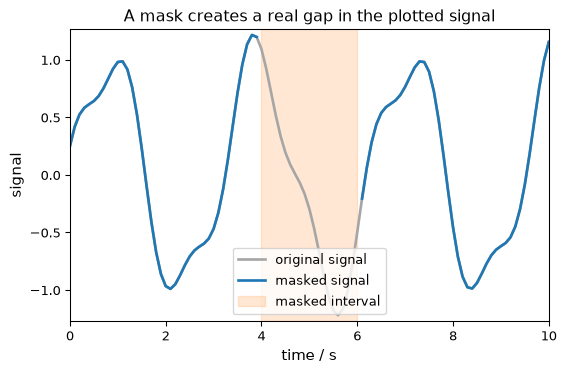
A longer signal makes the plotting behavior easier to see. The original signal is shown in gray. The masked copy is superimposed in blue, with the excluded interval highlighted. The blue line stops on each side of that interval: the plot does not interpolate across masked values. The gray curve remains visible there only as a reference for the stored original signal.
[14]:
time = scp.Coord.linspace(0.0, 10.0, 101, title="time", units="s")
original_signal = scp.NDDataset(
    scp.sin(2.0 * time.data) + 0.25 * scp.cos(5.0 * time.data),
    coordset=[time],
    dims=["x"],
    title="signal",
)
masked_signal = original_signal.copy()
masked_signal[40:61] = scp.MASKED

ax = original_signal.plot(
    color="0.65",
    linewidth=2,
    label="original signal",
    show=False,
)
_ = masked_signal.plot(
    ax=ax,
    clear=False,
    color="tab:blue",
    linewidth=2,
    label="masked signal",
    show=False,
)
_ = ax.axvspan(4.0, 6.0, color="tab:orange", alpha=0.18, label="masked interval")
_ = ax.set_title("A mask creates a real gap in the plotted signal")
_ = ax.legend()
scp.NOMASK is the NumPy sentinel returned when no value is masked. To remove an existing mask through the public dataset API, call remove_masks(). This operation mutates the dataset, returns None, and reveals the still-stored value; it does not recreate a deleted point.
[15]:
returned = masked.remove_masks()
print("Restored value:", masked.data[1])
print("Shape preserved:", masked.shape)
print("Mask after removal:", masked.mask)
print("Return value:", returned)
Restored value: 2.0
Shape preserved: (3,)
Mask after removal: False
Return value: None
Masked values are not NaN values
A NaN remains an unmasked numerical value. It propagates through the tested mean, whereas the explicitly masked value is excluded. Neither operation removes a coordinate or changes the dataset length.
[16]:
nan_spectrum = scp.NDDataset(
    [0.25, float("nan"), 0.75],
    coordset=[wavenumber.copy()],
    dims=["x"],
    units="absorbance",
)
masked_again = spectrum.copy()
masked_again[1] = scp.MASKED

print("Mean with NaN:", scp.mean(nan_spectrum))
print("Mean with a mask:", scp.mean(masked_again))
print("Both datasets keep", nan_spectrum.size, "positions")
Mean with NaN: nan a.u.
Mean with a mask: 0.5 a.u.
Both datasets keep 3 positions
Interoperability with raw arrays
Use NDDataset in normal SpectroChemPy workflows. Raw accessors deliberately carry less information:
datais an unmasked NumPy array; the dataset’s units, coordinates, metadata, and mask are separate and are not attached to that array;masked_dataandto_array()are NumPyMaskedArrayobjects that preserve the mask, but not units, coordinates, or metadata;valuesis a PintQuantitywhose magnitude preserves the mask and whose unit is retained, but it has no SpectroChemPy coordinates or metadata.
scp.MaskedArray and scp.MaskedConstant are the original NumPy types exposed for interoperability. scp.MASKED is an instance of MaskedConstant; they are not replacements for NDDataset.
[17]:
raw_data = masked_again.data
masked_data = masked_again.masked_data
quantity_values = masked_again.values
array_copy = masked_again.to_array()

print("data:", type(raw_data).__name__, "(mask and units separate)")
print("masked_data:", type(masked_data).__name__, "(mask retained)")
print("values:", type(quantity_values).__name__, "(mask and units retained)")
print("to_array():", type(array_copy).__name__, "(mask retained)")
print("MASKED:", type(scp.MASKED).__name__)
data: ndarray (mask and units separate)
masked_data: MaskedArray (mask retained)
values: Quantity (mask and units retained)
to_array(): MaskedArray (mask retained)
MASKED: MaskedConstant
Identity and further help
SpectroChemPy intentionally preserves the Pint registry, classes, exception, and the NumPy sentinels and masked-array classes. Therefore help(scp.Quantity) or help(scp.MaskedArray) can continue to show documentation from the originating library.
See Units, quantities, and masks for the stable SpectroChemPy integration summary and links to the external low-level references.